
21 Aug 2025
Ongoing training is essential – especially when you’re leading a team.
If you’re ready to level up and lead with confidence, now’s the time to invest in practical, real-world training that delivers results.
E-tec and the Skills Development Group are offering 20% off two of their most popular short courses:
Whether you’re stepping into leadership for the first time or looking to sharpen your project delivery skills, these courses are designed for tradies who want to lead effectively on and off the tools.
Use promo code: SKILLSTRADES at checkout to claim your discount. Offer valid until 31 December 2025.
Looking for more training options? Contact Catherine Spiller from Skills Development Group at [email protected]
20 Aug 2025
The EAS and EASQ registration classes are merging into a single class. From 1 September 2026, the limits of work for the EAS registration class will be extended to include disconnection and reconnection.
The EASQ registration class was revoked by the EWRB on 4 August 2025. If you currently hold the EASQ registration class, you can continue to work as usual. Once the new EAS work limits take effect, the EWRB will help you transfer to the EAS registration class.
You can no longer apply for the EASQ registration class, and the examination offered by Aspeq Limited for the EASQ is no longer available. If you have recently passed this examination, you may use your result to apply for registration as an EAS.
These changes are effective from 1 September 2025 and apply to both programmes:
Electrical Service Technician
-
- Electrical Service Technician registration class holders will continue to work under the 2019 Registration Notice until September 2026.
-
From 1 September 2026, if you are granted or renew your licence, you must comply with the 2025 Registration Notice requirements and work limits.
-
The experience pathway for this class will increase from 18 months to 2 years of practical experience in PEW from September 2026.
Electrical Installer
- Electrical Installer registration class holders will continue to work under the 2019 Registration Notice until September 2026.
-
From 1 September 2026, if you are granted or renew your licence, you must comply with the 2025 Registration Notice requirements and work limits.
-
The experience pathway for this class will increase from 2 years to 3 years of practical experience in PEW from September 2026.
-
A new option will also be introduced from September 2026, allowing registration after:
-
Being registered as an Electrical Service Technician for 1 year,
-
Completing 1 year of practical experience as an Electrical Service Technician, and
-
Meeting the examination requirements.

7 Aug 2025
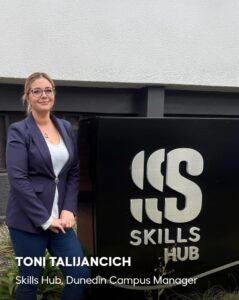
At Skills Group, women are driving change and shaping the future of vocational education. Among them are Di Lithgow, Director of Trades School; Toni Talijancich, Dunedin Campus Manager; and Margaret Moala, Campus Delivery Manager – all committed to empowering women in industries traditionally dominated by men.
Di brings over 26 years of experience in work-based learning. “Empowering women in trades isn’t just about employment,” she says. “It’s about building stronger communities and showing the next generation that leadership should look diverse.”
Toni’s pathway into trades was shaped by years in government and workforce development. “I never set out thinking I’d work in trades,” she says. “But trades build communities and offer transformational opportunities.”
Margaret’s career took an unexpected turn after nearly two decades in academia at AUT and the University of Auckland. “My journey began in IT,” she says. “But I felt a pull to explore private tertiary education. The trades sector is the backbone of this country.”
All three leaders see their roles as both a privilege and a responsibility. “Being in a leadership role means I can help bridge the gap between traditional education and hands-on training,” Margaret says.
While they all agree progress has been made, challenges remain. “Women still face cultural and gender biases, limited visibility, and the challenge of balancing family responsibilities,” Margaret says. “But the progress to date is real and empowering.”
Di points to Skills Group’s record number of female apprentices as evidence of change. “Once women reach 25% representation, workplace norms really start to shift,” she says. Toni adds, “We’re seeing companies move from token gestures to real change – improving facilities, offering mentoring, and tackling unconscious bias.” They also challenge outdated ideas about trades. “Trades don’t lack career progression,” Margaret says. “They offer dynamic pathways into leadership, business ownership, and specialist roles.”
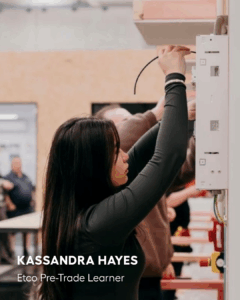
Di agrees that trades are highly skilled, well-paid, and increasingly innovative. One Skills Hub Christchurch campus learner, Kassandra Hayes, says hands-on training was the clear choice. “I always felt hands-on learning worked best for me,” she says. “I struggled with reading and writing and thought – why spend thousands on university when I could train in a trade with no debt and work my way up?”
She recently completed her pre-trade electrical course and is now looking for an apprenticeship. “What I love about electrical work is the never-ending opportunities – different types of work, always improving my skills, and knowing it’s a job that will never go out of fashion.”
Margaret’s advice to young women like Kassandra is simple. “Go for it with confidence. The trades offer rewarding, hands-on careers where your skills can make a real impact.”
“Empowering women in trades isn’t just about employment…It’s about building stronger communities and showing the next generation that leadership should look diverse.”


30 Jul 2025
We’re pleased to announce the appointment of Glenn Duncan as Head of Delivery within the Specialist Trades leadership team.
The Head of Delivery role is a pivotal one, with responsibility for our Campuses in addition to Field Services. This role is focused on enhancing the quality, reach, and reputation of trades training — with the goal of driving high-impact outcomes for learners, employers, and industry.
Glenn brings with him more than 30 years’ experience in executive and management roles, most recently as Chief Operating Officer at Literacy Aotearoa. He has also held senior leadership positions at BCITO and Builder’s Academy. Glenn’s background reflects a deep understanding of vocational education and a strong track record of working with industry to enhance workforce skills and increase accessibility for learners. His ability to lead teams, implement effective systems, and adapt to evolving educational needs will be an asset to us all.
We’re excited to welcome Glenn into the Specialist Trades whānau and look forward to the impact his leadership will bring.
21 Jul 2025
Executive Summary
This update from Skills Group, provides insight into current workforce trends across the electrical sector. While building work has slowed, demand for qualified electricians remains strong as electricity becomes more important across all aspects of daily life. This briefing looks at apprenticeship numbers, where the work is heading, and what’s driving demand for electrical skills.
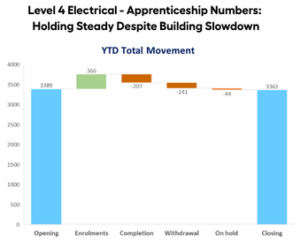 What This Chart Shows:
This chart tracks Skills Group’s apprentice numbers and shows something important – despite the building slowdown, apprentice numbers have remained stable. Starting with 3,389 apprentices, we’ve had 366 new sign-ups, with 207 completing their training, 141 leaving before completion, and 44 put on hold – leaving us with 3,363 at the end of the period (down less than 1%).
Industry Numbers from TEC
- Level 4 electrical programme learners across all providers: 6,126 (down from 8,134 in 2024)
- Skills Group has 3,659 of these learners (60%)
- Level 3 pre-trade programme learners industry-wide: 1,929 (down from 2,477 in 2024)
- Companies working with group schemes are taking on apprentices at more than double the rate (39.3%) of companies going it alone (18.2%)
Highbrook Skills Hub Opening
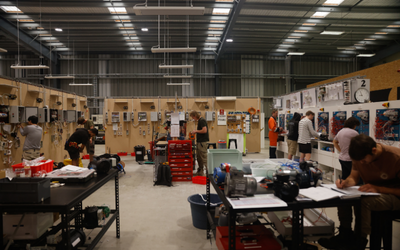
Skills Group proudly opened its third purpose-built campus in Highbrook, a state-of-the-art electrical training facility celebrated with industry leaders, students, and Minister Erica Stanford, marking a major step in our commitment to growing New Zealand’s skilled trades workforce.

Where the Work is Going
While residential building has slowed, several other areas are creating solid work for electricians:
Government Projects Coming Online:
- Faster consenting for major projects through RMA changes
- $22 billion for 17 major road projects across the country
- Water infrastructure upgrades creating work nationwide
- All these projects need qualified electricians from start to finish
Growing Work Areas:
- Solar and battery installations for homes and businesses
- EV charger installation and maintenance
- Building automation and smart systems
- Power grid upgrades and microgrids
- Data centres and network infrastructure
These areas are creating steady work even while house building catches its breath.
What’s Happening Around the Country
- Christchurch is showing good growth with 65 new sign-ups
- Auckland still has the most apprentices despite the slowdown
- Southern region is keeping more apprentices in training than the northern areas
New Training for Growth Areas
Skills Group has just launched three new programmes on renewable energy systems. These courses meet the EWRB qualification requirements for Registration with a Mains Parallel Generation Systems endorsement (covering grid-connected solar and battery installations) and are endorsed by the Sustainable Energy Association of New Zealand (SEANZ). Each course includes both theory and hands-on practical training, giving electricians the skills needed to work in the growing solar and battery storage market.
Looking Ahead
While the construction forecast shows a continued slowdown through 2025, the demand for electrical work looks solid for several reasons:
- More renewable energy means more electrical work
- More cars, heating and industry all moving to electric power
- Power grid needs upgrading to handle new demands
- Nearly every building system now involves electronics and controls
The electrical trade sits at the centre of these changes. As we work through this cycle, qualified electricians will remain essential to New Zealand’s infrastructure, economy, and shift to cleaner energy.

17 Jul 2025
A new suite of micro-credentials just launched by E-tec offers exciting pathways into solar installation for New Zealand’s electrical workers.
Designed for registered electricians, electrical engineers and inspectors to gain expertise in grid-connected and stand-alone photovoltaic (PV) systems, the NZQA-accredited micro-credentials reflect skyrocketing industry demand, and position E-tec – a part of Skills Group – as a leading provider of solar training in Aotearoa.
Mark Eagles, Manager of Quality and Standards at the Sustainable Energy Association of New Zealand (SEANZ), is hailing the new qualifications as a “milestone” for the sector.
“Offering a nationwide, structured training course for solar, PV and battery design/installation will create a clear pathway for any electrical worker to gain meaningful skills, obtain recognised qualifications and support the growth the industry needs to mitigate climate change,” he says.
E-tec has worked closely with SEANZ to develop the three standalone but stackable micro-credentials, which will be rolled out in Auckland this month, and Christchurch later this year. Depending on demand, other centres around the country may also be added.
E-tec Head of Industry Courses, Bill Sole, says electrical industry employers and wholesalers have been asking the provider to offer solar training for some time, underscoring the growing push towards renewable energy as a crucial tool in tackling climate change.
“We consulted with SEANZ, EWRB and the Workforce Development Council and they all told us of the need for nationally recognised formal credentials. Demand for cheaper and more environmentally-friendly renewable energy is only going to increase and solar systems will play an increasingly important role in fulfilling this demand,” says Bill.
What’s more, from September 1, when the Electrical Workers Registration Board’s (EWRB) new registration requirements come into force, the Solar PV and Battery Storage Systems micro-credentials will be accepted as the New Zealand Qualified Pathway for gaining a Mains Parallel Generation Systems licence endorsement (which includes all solar generation systems connected to the grid).
Until now, formal training credentials for the New Zealand solar industry have only been available in New Plymouth, through WITT, but thanks to E-tec, solar training will now be offered to a much broader audience – and in places of high demand.
“With the construction industry in New Zealand currently struggling, many electrical workers are looking to broaden the range of services they offer, and with Skills Group training hubs across the country, we hope to make this training easily accessible to electricians nationwide.”
Skills Group Director Trades School Di Lithgow is expecting the training to prove extremely popular thanks to the quality and convenience of E-tec’s courses and the growing appetite for solar energy.
“Each micro-credential involves self-paced online learning with tutor support along with a three-day block course at one of Skills Group’s specialist trades training facilities. This will help keep to a minimum time spent away from work training,” says Di.
The future certainly looks bright for skilled professionals in the renewable energy sector. In October 2022, Electricity Authority data showed that 43,641 solar systems have been installed across New Zealand.
“While uptake of solar systems in New Zealand has been slow to date, there is potential for greater utilisation as technology costs decrease, particularly at the grid-scale and on commercial building rooftops,” Di adds.
